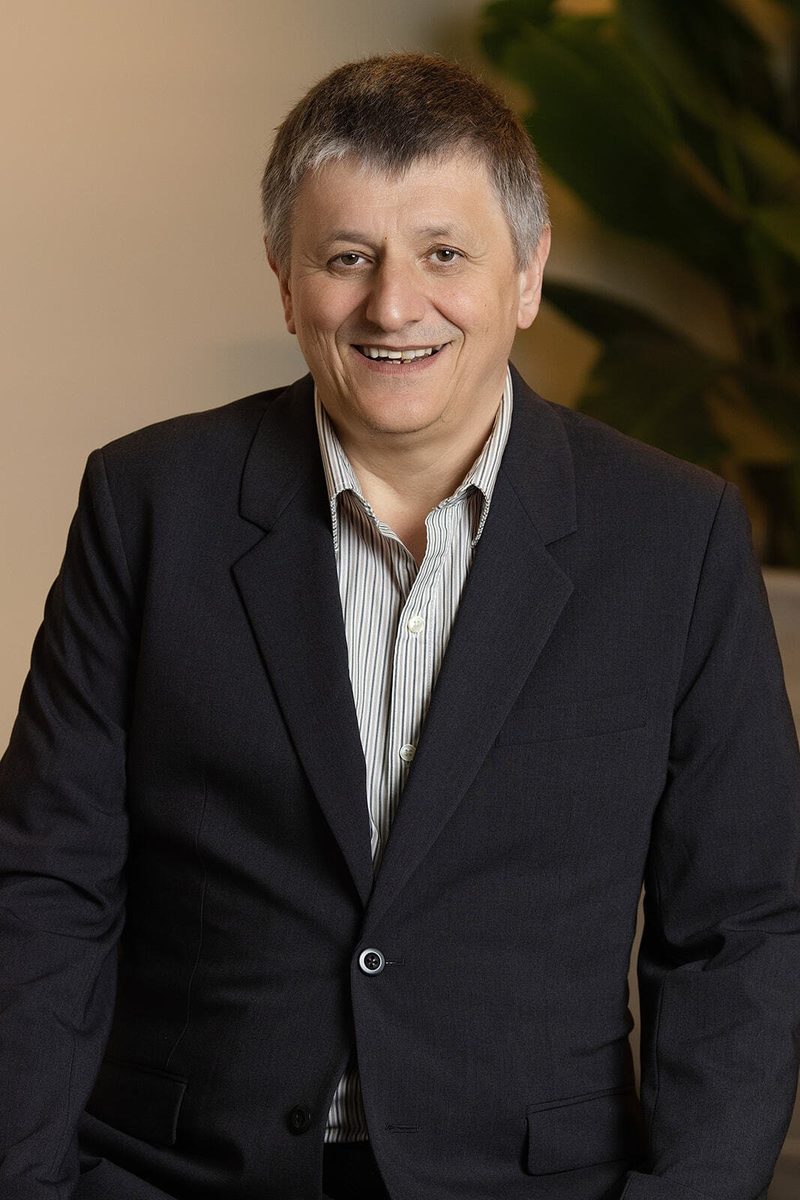
Dr. Milan Ilic, SVP of Power Systems
Becoming an Engineer
Q: Milan, thank you for being our inaugural interview for “The People Behind the Power at 1AP!” What led you to the work you do, and what inspired you to pursue this career?
A: After getting my Ph.D. at the University of Colorado Boulder in 2006, I started working in Colorado as an individual contributor at a company that was interesting at that time. Renewables had become very popular, and luckily that company opened a project that wanted to challenge the big players in the inverter area – Siemens, ABB. I was part of that team, a fresh guy with a Ph.D. in power electronics. They created a small team with the goal of creating something much better than anybody else had at that point.
Long story short, we were able to create the most efficient inverter. We increased efficiency from 95.5%, which was traditional, to 97%. That was a huge bump. It increased my confidence in my engineering capability, but it also showed me how you can deliver newer, better products by challenging what already exists. That has kept me rolling for the last 20 years in this field.
For those 20 years I was progressing in my career, getting to higher levels and management positions, but I always stayed close to my engineering teams, trying to drive the vision that what exists is not a limitation. We really need to look beyond that and see what else we can do better than anybody else. That's still pushing me.
“There is always a better way to design on the component level, or even the system level.”
Q: What drew you to pursue a Ph.D. in engineering?
A: A professor in Belgrade. I did my Bachelor's and Master's at the University of Belgrade and my diploma work with him, and he saw in me a willingness to go beyond standard methodologies, to look for new ways to do things. He thought a Ph.D. would teach me how to do that more effectively.
I started, but at that time the former Yugoslavia was breaking apart. War started, and my family and I decided we didn't want to go through that. We moved to the U.S. in 1997.
My first job here was at the General Electric R&D Center, and I thought I was probably giving up my dream of a Ph.D. The center had about 1,100 engineers, and about 1,000 of them had Ph.D.s, not only in power electronics or electrical engineering, but chemistry, physics, mechanics, pretty much anything General Electric was working on. After a year and a half I started feeling that I was one of the 7% in the company who didn't have one. So I went back. I applied to a few universities and selected Boulder, which had, and still has, a very strong power electronics graduate program. I worked with Professors Erickson and Maksimović, and that was a really great experience.
Why 1AP
Q: What drew you to 1AP now?
A: The renewables arena I started working in back in 2007 did not change much for almost 20 years. Companies were still approaching problems the same way: improve a little on the component level as new devices came out, optimize a bit of the cost. We kept building the same way we built in 2007.
Initially the renewable system was built only as a solar system, with PV panels. Starting in 2016, batteries got more and more popular, and today pretty much every system is a hybrid, meaning it has storage and PV. But they are still built as two independent systems. For the last five years I was intrigued by how we could build systems that are more optimized and more appropriate to what we are trying to build today. I tried to create some movement at my last two companies, coming up with ideas on how we could optimize the system for better efficiency and lower cost, but I couldn't get a lot of traction.
Then I connected with Tom, and to my surprise, Tom was thinking along the same lines. We connected very quickly and started sharing ideas about what needed improvement. An initial half-hour appointment became a four-hour discussion. After that I decided to join Tom and help the company with a clear mission.
“We want to build the best system, and then from there go down and create all the components that we need to build that system.”
Building the Team
Q: You now lead power systems at 1AP. Tell us about the charge of your team.
A: The goal for our team is to create everything electrical that we need for our system. That includes system design, which we work on very closely with Tom. We have electrical engineers working more on the system design, and a power electronics group in charge of designing the custom devices that enable our system.
We are creating a novel system, and some of the components we need do not yet exist. So we have to build a team capable of creating those components, and then keep improving them. Right now we have a very talented small team already designing the first component, and we're really pleased with how that's going.
Q: One of your co-workers talked about the freedom of starting from first principles and being able to take a fresh look at everything. Can you comment on that?
A: That's very important, and I think that's how we can attract talent. As an engineer, I enjoy working in a company like that rather than being told every detail of what I need to do. You get the chance to explore and rethink a whole area, to bring an idea you think is really good and work out how to implement it. Even if it has a 5% chance of succeeding, we'll review it and see if we can make it 100%, if it makes sense overall.
Q: There are so many different aspects to the work your team is doing. How do you think about priorities across multiple workstreams?
A: That's part of the challenge for me. I'm typically in discussion with Tom, along with a few members of my team, about how to optimize the system. Then we translate that into what it means for our own development, what components we really need, and we rely on our design team to come back with more realistic ideas and a sense of the timing. These are real things the engineering team brings to the table, and I have high trust in them.
I like to challenge my team by saying, “Oh no, no, no! We don't want to take the simple approach because it's a simple approach. We want to take the right approach!” If that takes a few weeks or a month more, we are willing to do it, if we think it's better technology for the company. With my experience in power electronics I can push and inject some ideas: what has already been done, what worked, what didn't. I give my team ideas to dig further into problems, and they come back with even better ones.
Q: How do you work with other teams, like operations or development?
A: Building systems is a lot of hardware, control and software, which is why 1AP needs a whole organization to do a project like this. Besides our power systems team doing system-level and component-level design, we have a control and firmware team, and beyond that, software and control at the system level. They are very talented people.
In parallel, Drew leads our supply chain and operations organization. We work closely with him on initial negotiations with suppliers, getting contracts in place, and getting all the components we need for our designs. As the design gets closer to finished, we'll work with him to find contract manufacturers and build quality and reliability engineering teams. Introducing this product into full production is coming soon, and that will be an interesting activity.
Q: What kind of team members do you need?
A: We're still a small team with open positions in almost every area. Power electronics and hardware. Control engineers, because we're building complicated systems that require a lot of control to keep running. A mechanical team – packaging, CAD designers, thermal designers – because we need to build something that goes in a box and works. Firmware engineers, to control the power electronics directly through our DSP. Quality and reliability engineers, to make sure what we build won't fail quickly in the field. And manufacturing engineers, to work with contract manufacturers and give feedback on how to produce our system more easily.
We're looking for people who can bring new ideas and who are not afraid to bring them, even if they are unexpected ideas. In many cases I've seen that something that starts out as a wild idea becomes a great idea. We encourage people to think freely and widely, and to enjoy their work with us.
Q: People on your team have followed you from place to place, building extraordinary innovations together. What is your special sauce?
A: I think people developing power electronics, learning and growing, like to be given the opportunity to take their own responsibility for certain tasks, and to be given a chance to really think outside the box and not be pushed back on their ideas. Those are the major things I always try to give to people working with me. I think they appreciate it, because it helps them grow and work on interesting things. That mix is probably what brings some people to keep working with me even when I was changing companies.
Q: What do you look for when hiring, specific expertise, or their thought process?
A: Beyond technical skills, we're looking for people willing to explore unknown things and not afraid to fail. We're also looking for people open to working as part of a team, because it's almost impossible to do everything yourself. Even in power electronics, we rely heavily on brainstorming, sharing ideas with coworkers, getting feedback, that's what helps you solve your problems and move faster. These teams are multifunctional. They require not only the power electronics people, but the mechanical people, the firmware people, and testing. All of those people need to work together to run a project effectively and get results.
“We're looking to have people willing to explore unknown things and not to be afraid to fail.”
AI and What Comes Next
Q: How is AI part of the work your team does?
A: AI has started playing a significant role in firmware development for now, mostly, but also in analyzing data and helping with quick evaluation. I was personally playing with it myself, giving it power electronics tasks and seeing what came back. It's pretty useful. It can cut through manual work and bring much faster results. What would normally take days, you may now get an answer in five minutes.
I think it's great that our company has a protected subscription to good AI tools, and that's something I've started encouraging more and more. I was making a joke recently with one of my power electronics engineers: AI picked up the same topology he had arrived at in his trade-off study, but he spent almost a month doing all the calculations and AI does it in five minutes. The only caveat with AI is that you may need to re-verify yourself once more, just in case. But it's a good tool, and I think we will learn to use it more and more.
Q: What does success look like for you?
A: Success is working in the right company, bringing value to the company, and seeing the purpose of the product we're building, in our case, renewable energy. Also, getting a chance to work with very smart and talented people helps me stay technically sharp.
Thanks, Milan!
1AP is hiring across power electronics, firmware, controls, mechanical and manufacturing engineering. See open roles